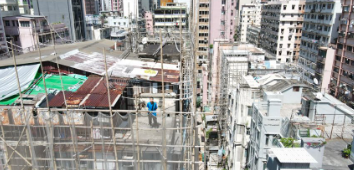
Picture Source: Blomberg
This is why 200,000 people live in homes smaller than a car.
Imagine being forced to live in spaces smaller than an average parking space. A flat surrounded by thin walls, low ceilings, and little to no light. For many Hong Kongers, this is the affordable housing accommodation they could find. As one of Asia’s leading financial centers and the gateway to China, Hong Kong is one of the wealthiest cities in the region, boasting a strong economy and a financial hub for foreign corporations. Hong Kong’s strong economy attracts many citizens from mainland China and other countries, which is a boon and a challenge for the Hong Kong Government. With the already large population of 7.5 million and the influx of new citizens, zone able land for residential development in Hong Kong is decreasing and the amount of available public housing is insufficient. The lack of affordable housing and government-subsidized public estates has forced many of Hong Kong’s residents to live in tight spaces, many of them having to cram into subdivided flats or cage homes, where a normal flat is shared with many people. This is the Hong Kong housing crisis.
Why is Hong Kong like this?
There are many reasons behind the current housing crisis in Hong Kong. The lack of land availability, the influx of new developments, and the way the government manages the land profile. But the key reason behind the soaring housing prices and the lack of housing is the way Hong Kong was established. When Hong Kong was a British colony, the colonial government imposed low taxes and relied instead on land sales to generate revenue. This is still the case today—land sales are sold for record high prices, creating a system that disadvantages the common citizen.
Recently, a plot of land in Hong Kong’s financial district, Central, was leased for an outrageous HKD$30B (USD$3.9B). Many of these land transactions are done through auctions, where property developers bid the highest to claim the land. Usually, these developers come from Mainland China, making astronomically high investments for a high return. To make the development profitable, investors cater towards the wealthy, building massive, expensive luxury housing complexes—complexes that the average resident cannot afford.
According to recent findings, the average Hong Konger would need twenty years of savings to buy a 500 sqft flat (HKD $8M or USD$1M); recent events like COVID-19 and anti-government protests have only accelerated housing inflation. Public housing waitlists start at five years, precluding many Hong Kongers from that option. This leaves few housing solutions for lower-class Hong Kongers: cage or “coffin” homes and subdivided flats.
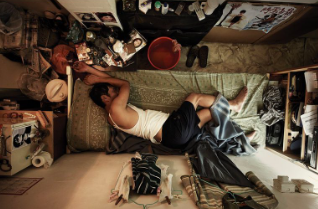
Picture Source: CNN
What are Cage homes and Subdivided flats?
Subdivided flats are normal flats that are converted to house many people. Cage homes, often referred to as coffin homes, are more brutal. The entire home is a sub-story, narrow box that is stacked between other boxes, providing enough room for a bed and some personal belongings. Bathrooms and kitchens are shared with others who live in the same flat. On average these spaces cost around HK $5000 (USD $640) per month and over 220,000 Hong Kong residents (3 percent of HK’s 7.1 million people) live in these spaces.
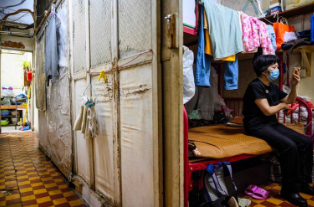
Picture Source: The Standard (HK)
A Problematic Solution
The government has enacted numerous policies that encourage home ownership to alleviate the high demand for rental units. In 2018, the government created a long-term housing plan for the next ten years in which there would be 400,000 flats constructed, 70 percent public and 30 percent private. Additionally, the government has released a new scheme called “Lantau Tomorrow” to develop unused land and build new islands to both provide housing and boost the economy.
As great as this sounds, there are qualifications. The 30 percent of private flats will face the same problem of being excessively luxurious at the expense of housing accessibility. The 70 percent will give native Hong Kongers the same problem of long waitlists and competition with mainland/foreign settlers. Especially with the borders reopened and Hong Kong’s economy expected to rebound after the pandemic, the advantages of new housing spaces will be partly negated by the influx of settlers. Instead, changing the system to limit subdivided housing and cage homes is what is needed to make the biggest impact on the housing crisis and Hong Kong society.
Sources: Wikipedia, HKFP, SCMP, gov.hk
Leave a Reply