Why China completely flipped its COVID policy in just One Month
OPINION | This is PART 2 of a 2-part article series. Read the first to learn about the psychological and social cost of China’s tight COVID policy.
I stepped into the mailing center to a cashier man surrounded on all sides by stacks of cardboard boxes. “Only four containers per box,” he told us unprompted, like countless people had asked him about that already. On the counter behind him were jettisoned bottles of Vitamin C pills, fish oil, and whatever was needed to keep our relatives healthy. A decent proportion of the local Costco’s off-the-counter section must have been in that room. I chuckled, the scene reminding me of the time the American-Chinese booked an entire flight of tickets just to stack every seat with masks. Imagine paying a first-class ticket for an amazon package of masks. But a day later, I was informed that a distant family relative passed away. And when I saw Chinese social media, I realized that it was just getting started.
The human cost of Ending Zero-Covid
January 8th marks the end of all COVID restrictions. The 387 passengers flying from Singapore and Toronto stepped onto the mainland without a PCR test, without a three week hotel quarantine, without even the later five-day hotel quarantine. Incomers face no restrictions so long as they are visiting for business or family; tourists still have limitations. This is one of many ways China has eased COVID restrictions following the protests of early December after the protests, either resulting from them or not.
But the sudden change in policy has left hospitals overwhelmed, medication stores emptied, and crematorium lines overflowing. More than a dozen countries have imposed COVID tests on Chinese travelers for a mix of geopolitical motives and outbreak concerns. Beijing called these limits “unacceptable.” If Beijing previously prioritized public health over civil liberties and was proud to have a command of the COVID outbreak, then why did it suddenly reverse? And given the torrent of infections and deaths, was it the best policy change?”
Is China Prepared for the Fourth Wave?
The latest outbreak affects two main groups, rural people and elders, because of sparse resources and vaccine hesitancy, respectively.
Many Chinese distrust the vaccine, their hesitancy stemming from poor experience with China’s homegrown vaccines and young clinicians. Many old people remember side effects from vaccines while they were younger, an extreme but rare case being paralysis from a vaccine for a neurodegenerative disease. Since older people often have other ailments, elders may be uncertain of potential side effects that come with the jab on top of their disease. SCMP writes, “Xiao [patient] said he was confused by the different opinions from the doctors he consulted, and the lack of clarity about the standards they were based on, and he could not find other patients with similar conditions to ask their advice.”
In a summer 2019 Shanghai survey of 1021 participants, 73.8% were concerned about vaccine side effects and 52.4% about vaccine effectiveness. According to official data, only 69.8% of 60+ year olds are vaccinated, and only 42.4% for 80+ year olds. Vaccination is a society’s best shot at herd immunity, and China could have benefited a lot from developing more reliable vaccinations and having a more gradual opening up. While China did run vaccination campaigns, they spent a disproportionate amount of resources on encouraging the jab — often with borderline force in rural areas — rather than making it trustworthy. Campaigners were sometimes incomplete on the job, deeming the job completed after a set percentage of villagers were vaccinated, neglecting unintended consequences and vaccine side effects.
Rural villages, home to 36% of the Chinese population, are also hit hard with the new wave. During Zero-Covid, where containment was the watchword, people had little incentive to get vaccinated. Vaccines were suspended as clinicians and medical equipment was redirected towards testing. The better strategy would be to sacrifice some testing, which only ensures short-term prevention, and dedicate a margin of resources to vaccination, long-term prevention. As people with vaccine hesitancy cite a lack of peer confirmation of vaccine effectiveness and safety, this strategy could be an indirect way of promoting trust in a more reliable vaccine.
Rural sites are also challenged because doctors are more sparse for both geographic and economic reasons. China’s rural land has 1.48 doctors and 2.1 nurses per 1000 people, less than half of the 3.96 and 5.4 nurses for urban areas. According to Chinese officials, there are only 4 ICU beds per 100,000 people. Coupled with vaccine hesitancy, rural areas are left especially vulnerable.
What is China Doing to Prepare?
China’s shifted its focus from prevention to vaccination and treatment. China plans to increase the elderly vaccination rate to 90% by the end of January, boost ICU beds to 10% of all medical beds. It’s developed a disease severity hierarchy to make treatment more efficient. It’s also mandated that 90% of villages have fever clinics by the end of March. Panic-buying, reminiscent of 2020 America, is soaring, and the government demanded that “all localities should provide 15-20 percent of the population served by township clinics with traditional Chinese medicine, antipyretic, cough and other symptomatic treatment drugs and rapid antigen test kits.” Not all hope is lost, but Chinese authorities must prepare quickly for the opening up, and with as little coercion as possible.
Why Reverse so Suddenly?
In just one month, China went from a week-long quarantine to none at all. In just one month, Chinese state media went from warning people of the virus’ danger to calling the Omicron variant “mild.” What happened?
The U-turn may be a passive-aggressive move to prove Zero-Covid’s effectiveness and how the general public cannot be trusted to maintain discipline. While the policy has changed, the desire to prove an ideology has not. The move is unwise for both the Chinese population and the party’s reputation. A better way for the party to gain trust would be to institute reasonable mandates that balances minimizing infection with minimizing psychological and emotional costs, a strategy that aligns both party and public needs. Getting the public to cooperate by forcing their trust through propaganda and exposing their lack of discipline is less effective than earning their cooperation through trust based on humility and accountability.
The ideas below are expressed by Victor Shih, a Chinese Politics expert at the UC San Diego School of Global Policy and Strategy
A less cynical explanation is that factions of the government which had advocated for vaccination and opening up over draconian lockdowns had only recently been empowered by the mass protests. As Chinese media is so tightly controlled by the censorship department, top authorities may have never found out about dissent and side problems until a multi-city protest erupted. This, again, reveals how China’s government is not enough of a closed-loop system.
The most forgiving explanation is that the Chinese government has been preparing for the open-up for a long time now, and only did so when opening up would be less catastrophic than thought. Opening up in 2020 would have easily overwhelmed the relatively limited medical system of 2020 China, but today’s China would be better equipped to handle it. Rumor has it that Wang Hu Ning, advisor to Xi, is one advocate of opening up. Wang, despite being just a professor, shows no political ambition and is easy for Xi to trust, and so has considerable leverage in policy revisions. Another exponent of the new policy was Sun ChunLan, who announced at the National Health Commission on Nov. 30 that “Our fight against the pandemic is at a new stage and comes with new tasks.” This was concurrent with the protests and suggests that the “new tasks” have been in development for some time until then.
A definite part of opening up is economic stagnation. While the party cites it partly to avoid mentioning the protests, there’s no denying that almost all service sectors, employing the majority of young people, have halted. Chinese students have organized many college campus protests over unemployment on a scale “not seen […] since 1989.” Competition with the US is an issue close to the leaders’ hearts and also a major impetus for opening up.
So, Do Protests Work in China?
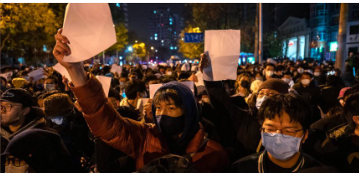
We now understand that protests, coupled with more liberal factions of government, worked to create the policy change that is China today. What kind of precedent is set when an authoritarian government listens to the people? Shih says that the public will be much more willing to voice themselves when they know there are sympathizers. Since censorship was previously so tight, everyone played a “prisoners’ dilemma”; If there were no sympathizers, the lone protester would look terrible and get arrested. Playing it safe, most people kept to themselves. But in the future, people will be empowered in the knowledge of their solidarity.
As for the government, programmers are working on machine learning to quickly censor news of protest so that insurrection does not spread from city to city through social media. This again is a double-edged sword, saving face and ensuring social stability in the short term but undermining trust in the regime.
An Overall Assessment
It is difficult to quantify whether the new policy is better. Certainly, no one will not have to download 12 food-purchasing apps or pool money to have someone with a “green code” buy food for them. None will be arrested for walking in public after not taking a COVID test on time. No nurse will die of asthma after being denied treatment at her own hospital until her negative COVID test comes back.
But taking it to the other extreme certainly has its risks. China isn’t prepared for a new outbreak, which could take over a million lives over the next four months and infect 60% of the population. (This number may be off because Chinese officials have encouraged doctors to underreport numbers, giving predictive models less data to work with.) While the current outbreak confirms the CCP’s brags that lockdowns kept the virus at bay, the government was not accountable for the severe side-effects of their lockdown policies, and similarly may not be in their new one.
In addition to vaccination, social distancing and mask policies can save up to 200,000 people by April, and the lighter load on hospitals will allow health professionals to treat patients more efficiently. The party seems not to have instituted such mandates, but perhaps may be instituting them, as well as even buying western vaccines, soon.
At the end of the day, whatever rules get implemented—politically motivated or not—Chinese people across the globe will have each other’s backs. Be it sending made-in-china masks back to China on first class tickets, or holding A4 papers to speak the unspeakable, we’ll do whatever it takes to brave the wind. Many individual sticks are easy to break, but if bundled up, the worst tornado can’t do anything. Let’s bundle up. Fighting!
Leave a Reply