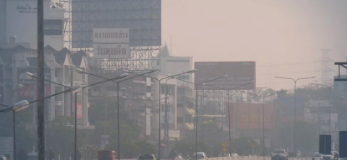
Picture Source: The Nation Thailand
“Reports from the year 2021 show that air pollution contributed to over 50,000 premature deaths in Thailand”
Over the past few weeks, 53 of Thailand’s 77 provinces’ air quality has plummeted to disturbing levels, but this is only the start of the real problem. The main pollutant in Thailand’s air is particulate matter that measures 2.5 microns or less in diameter (also known as PM 2.5). These particulates both harm health and reduce visibility. The Environmental Protection Agency (EPA) designates healthy PM 2.5 levels at 12 ug/m3 or lower. Thailand’s capital Bangkok had ranges between 55.6 µg/m³ and 81.4 µg/m³ consecutively from March 6th to 10th. Although the concentration of PM 2.5 has dropped down to a lower concentration level on other recent days, those levels are still far from being healthy enough to breathe in. Chiang Mai, another of Thailand’s provinces, has a consistently even higher PM 2.5 concentration of above 150 ug/m3, ranking it 4th in IQ Air’s worst air quality ranking for cities worldwide.
PM 2.5 is one of several pollutants used to determine the overall air quality index (AQI). So why do we focus on PM 2.5 rather than the AQI? This is because those particles are small enough to travel deeply into the respiratory system and directly affect the lungs. The effects from inhaling the pollutant can include a wide range from short-term effects like eye, nose, throat, and lung irritation to long-term effects like an increase in mortality rates and higher death rates from cardiovascular diseases, respiratory, and cancer. Reports from the year 2021 show that air pollution contributed to over 50,000 premature deaths in Thailand. Air pollution has been affecting countries around the world on a worrying level, and many do not realize the harm it will cause. This has been a recurring problem in Thailand, and many rounds of bad air quality have happened in the past. So, why is this one important now? First of all, animals are even more vulnerable than humans, as they don’t have the necessities (like masks and air purifiers) to protect them from these chemicals. This will lead to higher rates of endangered species, as well as lead some to extinction. Aside from health concerns, researchers also found that high concentrations of PM 2.5 can acidify rain and bodies of water, increase ozone depletion, damage crops and forests, and harm ecosystems. Additionally, a haze decreases our vision, which makes it harder to see clearly especially on roads.
Without prevention or action, air pollution will eventually spread to everywhere in the world, creating irreversible damage to both the environment and our own health. It is a huge factor that contributes to climate change. It is up to us individuals and the government as a whole to avoid damaging the world even more than it is now. We know that air pollution (or any type of pollution) harms the environment, but what exactly are those damages?
Acid rain
Eutrophication
Haze
Effects on wildlife
Ozone depletion
These outrageous measures of bad air quality Thailand has not only come with environmental side effects, but takes a toll on our own health as well, which results in 50,000 premature deaths in 2021.
Leave a Reply