What can we learn about the Myanmar coup through the Gwangju uprising (1980) in Korea?
OPINION | A historical comparison
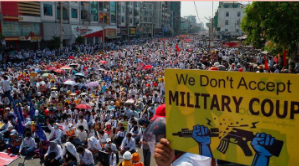
Does everyone remember the Myanmar coup in 2021? The Myanmar coup d’état began on the morning of February 1st 2021. The National League for Democracy, the democratically elected leadership of the country, was deposed by the Tatmadaw, Myanmar’s military. The news was in the headlines and on the front pages of newspapers. “Breaking News!” quickly crossed TV screens around the world. However, after the government blocked telephone lines, internet access, banks, and stock markets, there have not been frequent updates about the current situation in Myanmar. It is almost certain, however, that violence has continued and the resisting force has evolved since 2021. Despite our lack of knowledge about Myanmar, we can learn indirectly from a similar coup that happened in South Korea during the 1980s.
On the 16th of May 1961, Park Chung-hee and his allies took over the Korean government. Their dictatorship lasted twenty seven years—that’s 50% of South Korea’s life expectancy at the time. During Parks’ regime, the country had a lot of opposition against the government. Citizens, especially students, risked their lives to protest in the streets. People who got caught would be jailed and tortured. Among the brutal acts the government has executed upon its own citizens, the most significant violence that happened was the Gwangju Uprising, also known as the 5∙18 Democratization Movement, on the 18th of May 1980.
The uprising began after local Chonnam University students who were demonstrating against the martial law government were fired upon, killed, raped, and beaten by government troops. Between six and twenty-three hundred civilians were killed by military troops in this uprising. The government quarantined the city so that no information about their killings was reported outside. Fortunately, a German news reporter, Jürgen Hinzpeter, was able to record a video of the uprising and expose the tragedies to the public.
The massacre continued for 9 days before the military troops canceled their reentry operation in Gwangju. The 5∙18 Democratization Movement was an event that attracted attention not only in Korea but also in Asia and the world as a protest against dictatorship and authoritarian regimes. It is recognized as a solid stepping stone for the democratization movement, the human rights movement, and the peace movement. In addition, the 5∙18 Democratization Movement set a precedent for stimulating democratization, human rights, and peace movements in many Asian countries.
The Gwangju Uprising happened in a short period of 10 days, but it was a spark in the development of Korean modern history that created a history of pride. It was a bold statement that citizens have the right to resist unjust state power. The people no longer stayed on the periphery of the politics that shaped their lives; they became the subject of social development. The protest experience formed the concept of “the people” in the Korean democratization movement, and moreover empowered citizens rather than state to drive the development of Korean society.
The similarities between “the 1980 Gwangju Protest” and “the 2021 Myanmar Protest” are uncanny (Chen, 2021).
First, both movements remained resistant to the vicious forces of the military.
Second, the military attempted to curb both movements with brutal violence. But the peoples’ spirit was unyielding. As the movement of civil disobedience intensifies in Myanmar, the people of South Korea are reminded of what they experienced.
Third, individuals in both movements were fighting against special forces known for their cruelty.
Fourth, the special military units from both countries indiscriminately arrested citizens – those who were actively involved in the protests and many who were not.
Fifth, the two nations’ military divisions took control of the newspapers and broadcasters to spread false reports. In doing so, they minimized the impact of such violence, reducing the number of deaths and creating a false story of outsider intervention.
Sixth, through the distorted presentation of innocent citizens as rioters, both of them justified the brutal suppression of the military as exercising the right to self-defense.
The situation in Myanmar and 1980 South Korea is similar, and the May 18 Memorial Foundation, founded to assist people who lost family to the Korean military in 1980, eagerly supports Myanmar in its fight for democracy. Jin-Tae Jo, Director of the May 18 Memorial Foundation, said: “We will do everything. We’ve decided to build a coalition here in Gwangju to help the Myanmar people . . . We seek to procure necessary goods for Myanmar in association with all human rights movement organizations operating in Gwangju Metropolitan City. Masks and a variety of medical supplies will be more needed by Myanmar than ever.” Just as Myanmar has suffered under martial law like Korea, so too will they realize the dream that every voice counts. If the citizens of Myanmar continue resisting the oppressive militaristic government, the day of democratization will come.
Leave a Reply