A Review of China’s Zero-Tolerance Days
OPINION | This is PART 1 of a 2-part article series. Stay tuned for more recent developments.
Translation: “Let’s put food before COVID tests. Let’s put freedom before lockdown. Let’s put dignity before lies. Let’s put reform before cultural revolution. Let’s put elections before dictatorships. Let’s be citizens, not slaves.”
The human cost of Zero-Covid
Written by an anonymous “Bridge Man,” this October 13 poster encapsulates Chinese citizens’ growing dissent towards Xi and the Zero-COVID policy. While the western world has been accused of prioritizing economic profit over public health, China has done the opposite extreme, following a stringent prevention-is-the-best cure strategy for the last three years. Up till recently, Beijing international arrivals had to spend three weeks in hotel quarantine and one week at home. Moving between Chinese cities meant three weeks of lockdown. One positive test from the many routine COVID checks meant lockdown for the entire complex.
The zero-tolerance policy worked, but it came with a devastating price. Mothers could have been saved if they were allowed out of residence for childbirth. An epidemic of depression and social isolation could have been averted. Parents and children didn’t have to be separated for quarantine camps. People would not have to worry about food, medication, or menstruation supplies. And infamously, the Ürümqi fire may not have killed eleven on 24 November—thanksgiving day—if people were allowed to flee.
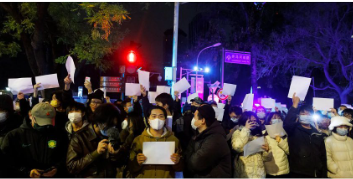
The Urumqi fire sparked a wave of protests from Chinese around the globe, dubbed the “#A4 revolution.” Protesters carried blank A4 papers to “say what cannot be expressed in words” due to censorship. The protesters themselves are found and arrested if their faces were found on camera. On November 23, a violent labor riot erupted outside an iPhone factory after workers did not receive the promised pay because of production delays from COVID restrictions.
四月之聲 (“Voices of April”), an video documenting the first-hand accounts of Shanghai resident’s struggles to get enough food, was also removed in a cat-chase-mouse censorship campaign.
“Distribute supplies!” chants residents.
“If only I was allowed to interact with them,” journals one residential leader.
“I’m more heartbroken than you right now. You’re only seeing your family in distress. I see countless families. I’ve reported your situation, made you countless phone calls. Sorry, Dr. Yu, I’m over a barrel,” apologizes a residential leader over the phone.
“Everyone’s competing for bedsheets […] some of the beds aren’t even up, I guess we’re sleeping on the floor,” chronicles one quarantine camper.
“Falling ill might not kill you, but falling hungry will”
Why all of this?
Since China kept the numbers low during the outbreak of COVID, it has pushed the narrative that “Marxism-Leninism with Chinese Characteristics” can handle COVID better than any other system. To Xi, China’s system of individuals sacrificing freedom for the collective good is more effective than the Western policy of opening up while sacrificing human life. Living inside this narrative, the central government has been hesitant to loosen its grip. Political motives are also behind the CCP’s reluctance to approve more effective foreign mRNA vaccines. Effective vaccines promise both less need for quarantining as well as herd immunity to COVID. However, they see relying on foreign vaccines as an admission of weakness for their system. A hole in their covid-perfect story.
In China’s system, everything is done to code. But executing paper-written instructions without regard to its real-life impact is a recipe for disaster. All sustainable systems are closed-loop, meaning it adjusts itself using feedback. Yet instead of taking feedback, a vital tool for improvement, the government has rejected it through active censorship. To save face.
On censorship, one Weibo user wrote, “It’s just a record of actual events, what good does it do to censor it? Originally, we were just sad, not angry. Now it’s a revolt of the people. A cover-up only makes matters worse.” The government is so out-of-touch with the public that they can’t see how their censorship strategy doesn’t save their reputation. On the contrary, it exposes their irresponsibility.
“Tonight is the night of the deleted voices [404之声]
Leave a Reply